Why did Ganga throw her seven sons into the river? The story from the Mahabharata
Ganga threw her seven sons into the river to break a curse from the Vasus, fulfilling Shantanu's wish and Devavrata's vow, as per the Mahabharata.
🌐 This translation was made by AI. Read the original Hindi article
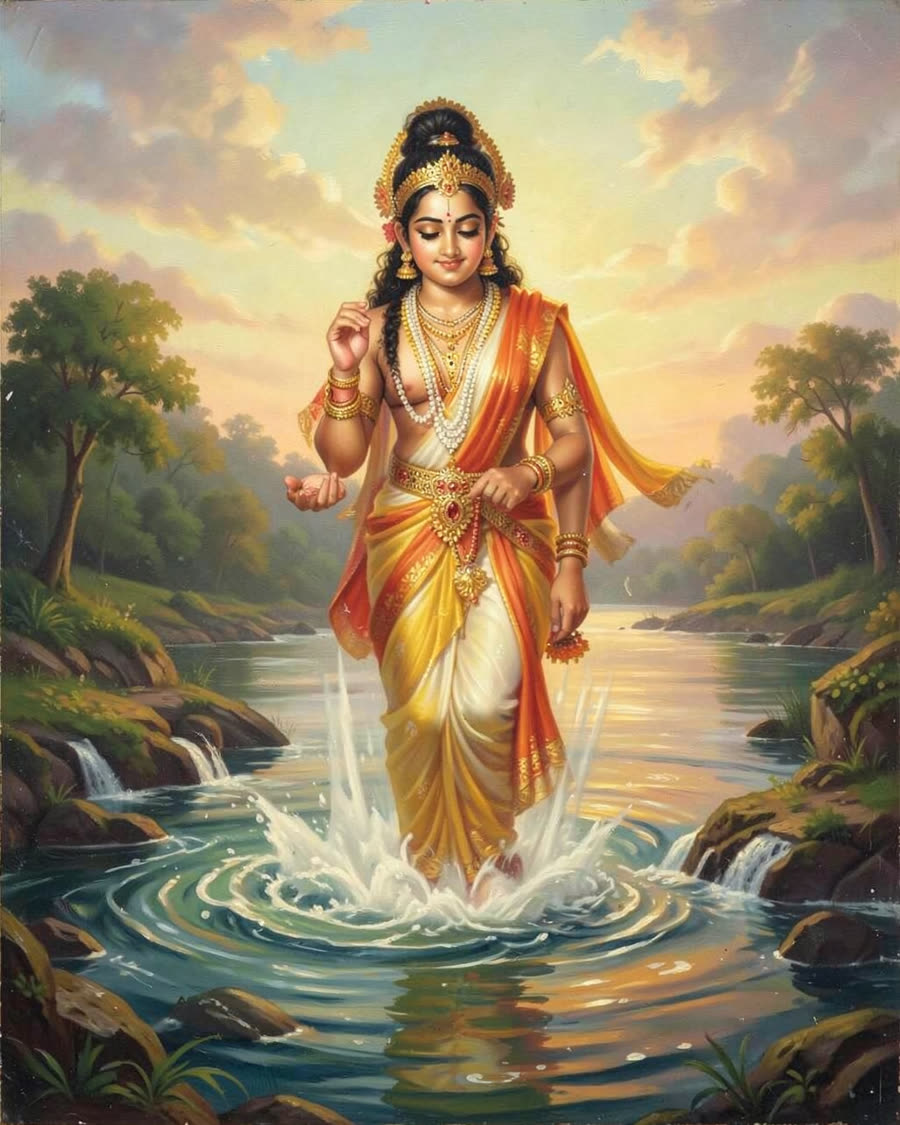
The most poignant question in the story of Shantanu and Ganga is this: How could a mother throw her newborn children into a river? The answer to this lies within a curse, a stolen cow, and a promise, as described in the Adi Parva of the Mahabharata. Below is the sequence of events as presented in the text, and where the text remains silent, we too remain silent.
The Woman Sitting on the Right Thigh of Pratipa
The story begins with Pratipa, the father of Shantanu. King Pratipa was performing austerities near the source of the Ganges, when a beautiful woman emerged from the water and sat on his right thigh. She said that she wished to be his wife. Pratipa refused. He said that he did not look upon foreign women with desire, and that the right thigh was the place for a daughter or daughter-in-law to sit, while the left thigh was the place for a wife. Therefore, he would accept her as the wife of his son. This woman was Ganga, and from here, her relationship with Shantanu was decided.
Marriage and That Condition
Later, Shantanu became a king and met Gangā. Before the marriage, Gangā set only one condition: the king would not interfere in her affairs, whether they seemed good or bad to him, and he would never speak harshly to her. The moment the king interrupted or spoke harshly, she would leave him forever. Shantanu accepted the condition. According to the scriptures, they were so pleased with her nature, appearance, and service that months, seasons, and years passed without them even realizing it.
- 1
Pratīp and the Ganges
The right thigh is the place of the daughter or the daughter-in-law, therefore the wife of the son of the Ganges will be born.
- 2
Shantanu's Condition
The king will never interfere in their work.
- 3
Eight Offspring
As soon as the seven were born, the Ganges threw them into the river.
- 4
Eightfold Path
Shantanu stopped him and asked who he was.
- 5
The Truth About the Ganges
They were the eight Vasus, who became humans due to the curse of Vashishtha.
- 6
Devavrata
The eighth child was named Ganghey and Devavrat.
Eight Children and the River
From this marriage, eight brilliant children were born. But each time, immediately after birth, the Ganges would throw the child into the river and say, “This is for your own good.” Shantanu, seeing this, was distressed but said nothing, for he was afraid that his wife would leave him. This happened seven times.
When the eighth child was born, Shantanu could not remain silent. He stopped her and asked who she was, why she was killing her own children, and how great a sin this was. This was the very moment for which the Ganges had previously set a condition.
Ganga’s Answer: They Were the Eight Vasus
Ganga did not kill the child, but told him that the condition had been fulfilled and now she was leaving. She introduced herself as Gangā, the daughter of Jahnu. The eight children she had given birth to were the eight Vasus, who, due to a curse by Vashishta, had to take birth on earth in the form of humans. There was no father on earth like Shantanu and no mother like Ganga for them, so this relationship was formed. At the same time, it was decided with the Vasus that as soon as they were born, Ganga would free them from human life.
Who Cursed and Why
When Shantanu asked, Ganga narrated the full story. Near Mount Meru was the hermitage of Vasishtha (also called Apav here), where his cow Nandini, as precious as a wish-fulfilling cow, lived. One day, the Vasus came there with their wives for a visit. Dyau, the wife of one of the Vasus, saw Nandini and asked her husband to take the cow for his friend. Dyau, along with his brothers, stole the cow, forgetting that it belonged to a sage.
Vasishtha, having learned everything, cursed them in anger, saying that the Vasus would be born on Earth. The Vasus begged for forgiveness. The sage said that the other Vasus would be freed within a year of birth, but the one who caused this offense, that is, Dyau, would have to stay on Earth for a long time. He would be knowledgeable about dharma and scriptures, obedient to his father, but he would have no offspring.
Seven Freed, the Eighth Devavrata
The Vasus had asked Ganga for this boon from Ganga herself that as soon as they were born, they should be thrown into water and freed from human life. Therefore, Ganga did so. Only Dyau had to stay on earth for a long time. Ganga took the child with her and the child grew up to be named Gangey and Devavrata. Later, he was known as Bhishma, who remains at the center of the story of the Mahabharata.
What Do We Learn from This Story
First, the text does not portray Ganga as cruel. She is fulfilling her vow, and Shantanu’s silence is also bound by the same vow. Second, this story is about a curse and liberation, not about murder: the Vasus were in need of liberation quickly. Third, the details of this story vary slightly in different traditions and retellings, so it is a good idea to compare what is read from TV serials or folk tales with the actual text of the scripture. Here, we have taken K. M. Ganguli’s English translation of the original parva (possible parva) sections 97 to 99 as the basis.
Frequently Asked Questions
Did Ganga kill her children? According to the text, she immediately after birth threw seven children into the river, but this was to free herself from a curse at the request of the Vasus.
Why was the eighth son saved? Shantanu intervened, and Ganga had to leave as per the vow. At the same time, according to the curse, Dyau had to stay on Earth for a long time.
Who was that eighth son? Gangadatta, Gangeya, or Devavrata, who later became known as Bhishma.
Is this story the same in all texts? No. This is the account from the Adi Parva of the Mahabharata, and other Puranas and folk traditions contain different details.